Connected Infrastructure for Resilient Communities & Local Economies (CIRCLE)
Why CIRCLE
Data centers are becoming major infrastructure investments in communities across the country. They bring significant capital and economic activity, but they also create substantial demands for energy, water, land, and infrastructure. Too often, the community bears these costs while the value created by the investment flows elsewhere.
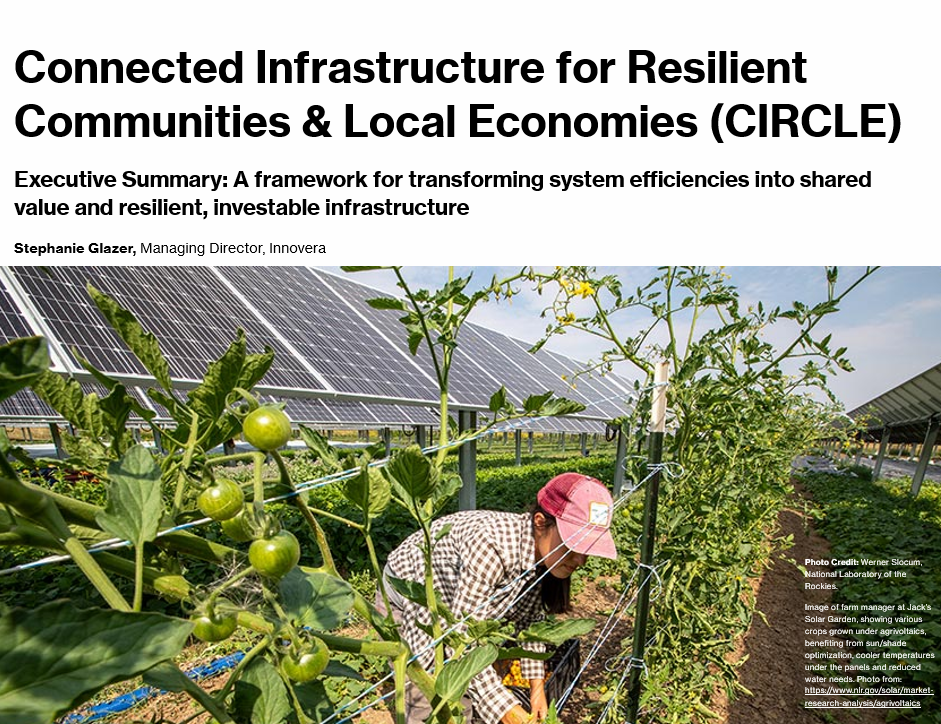
CIRCLE starts with a different premise: a data center can be the anchor customer and financial engine for a broader infrastructure system that also serves the surrounding community. CIRCLE makes community infrastructure part of the core project — planned, financed, built, operated, and maintained alongside the data center itself. The data center gets the reliable infrastructure it needs; the surrounding community gains lasting access to clean energy, water resources, thermal recovery, agricultural production, economic opportunity, and other locally defined benefits.
Building the infrastructure is only half the challenge. The critical question is how to ensure it actually functions as intended, and continues to do so for the life of the project. That is the problem CIRCLE is designed to solve.
What is CIRCLE
CIRCLE is a framework for designing, financing, governing, and operating integrated infrastructure around a data center or other major infrastructure anchor. It connects systems typically planned separately — clean energy generation and storage, microgrids, thermal recovery, water systems, agrivoltaics, productive reuse, and community infrastructure — into a coordinated platform that creates value for both the data center and the community.
CIRCLE achieves this through four mutually reinforcing structural mechanisms, each addressing a different part of what makes integrated infrastructure durable:
System design logic that identifies where value can be created,
Execution vehicle that builds and operates the infrastructure,
Capital and governance structure that keeps community benefit intact over time, and
Enforceable standards that hold performance to account across the life of the project.
These mechanisms help ensure that a host community’s rights and agreed-upon benefits are translated into binding contracts. Together, they address a fundamental weakness in conventional infrastructure development: a community benefit promised at the outset of a project can disappear over time.
The CIRCLE framework outlines each structural mechanism, the community rights they secure, the contractual toolkit that makes those rights enforceable, and the legal precedent underlying the Community Benefit Investment Trust’s (CBIT) novel design.